Recovering during a step-back week

I’m pretty decent about taking one full day off per week, understanding that the rest lets my muscles get the full benefits of all the hard training I did the week before.

Know what I’m not so good about? Step-back weeks, the entire weeks where you step back in mileage and intensity after two hard weeks of training, are components of basically every marathon-training program known to man. Problem is, I’m not following a training plan right now, since my stubbornly sore IT band has forced me to put my Marine Corps Marathon training on hold for the moment. This means I’ve basically been plowing through my training willy-nilly, often beating the crap out of myself for no reason, with very little rest after.

Case in point: On Sunday, I did two hours of lifting and core work, telling myself doing a 5-minute plank on the BOSU was the equivalent of the 14-mile run I was missing. This followed a week of hard running and swimming, and I’d planned to follow it up with — yep, a week of hard running and swimming.

Then, my body rebelled with a nascent cold. I’m not sick yet, but my body’s considering whether to give in to the aches and congestion that have stopped in for a visit. For once, I’m being smart, and am chilling out this week to prep for the Crystal City Twilighter 5K on Saturday night. I’m considering it a sort of forced taper, or a nasty reminder that my unofficial “training plan” should include some step-back weeks, too.

How do you incorporate rest into your training? Share your strategies by posting a comment below.

3 Comments

Filed under Uncategorized

Too sick to run?

Earlier this week, I wrote a post about how hard it is to stop a body in motion, when that body is yours and it is injured and your doctor has warned you to give that body a break. Today, I got a sign from the running gods that really, it’s time to chill out for a day or two.

Last night, my body got hit with a weird, flu-ish haze that left me achy and exhausted, with a tiny bit of head congestion, like my body’s deciding whether it really wants to be sick. This left me deciding whether I wanted to attempt my group run with Pacers Silver Spring tonight.

I followed what David Nieman, Ph.D., who heads the Human Performance Laboratory at Appalachian State University and has run 58 marathons and ultras, calls the “neck rule:” Symptoms below the neck — a chest cough, or body aches — require time off. Symptoms above the neck — a runny nose, stuffiness, sneezing — and you’re good to go.

Given that the body-aches and exhaustion are nothing if not neck-down, I opted to play it safe and stay home. Still, I was totally jealous as I watched Steve get dressed to meet our running group, even though I felt too tired and achy to even contemplate getting up to refill my Nalgene with water.

Steve answered the “am I too sick to run” question for me by reminding me that we’re planning to run the Crystal City Twilighter 5K on Saturday night. “Don’t sacrifice Saturday for a run you won’t get anything out of tonight,” he said.

He’s smart, that guy. He knew that the real question was: Is it smart for me to run tonight? The answer to that one was an unequivocal “no.”

In case there was any doubt, I reverted to a rule my mom had for me in high school: If I was too sick to go to school, I was too sick to go to swim practice after school. I actually laid down for a nap today, which are usually physically impossible for me, during what I consider my working hours. Too sick for school, too sick for practice.

Wondering whether you’re too sick to run? Get more insights from Nieman in this great Runner’s World piece on the topic. For more insights from my mom, I’m not sure what to tell you.

Now, if you’ll excuse me, I’m off to pop some more echinacea and Tylenol Sinus.


5 Comments

Filed under Uncategorized

Stopping a body in motion

I’d really been doing OK not training for the Marine Corps Marathon yet.

I’ve been sticking to 5 or 6-milers three times a week, as discussed with my running doc, and had been doing just fine without long runs and speedwork, which he explicitly outlawed until at least August. The hip’s been doing … you know. Fine. Not great, but fine.

Then, last weekend,  some friends who are running MCM mentioned to my husband, who in turn mentioned to me, that they were running 14 miles on Sunday. This is fabulous for them, but I felt left out and crappy and gimpy and lazy, despite starting my Saturday with a truly lovely 5- or 6-mile trail run and about an hour of core and hip work after.

I know the only solution is to get over myself, and to get my head back in the right place. By the way, I think it’s awesomely ironic that I’m feeling down after a week of focused mind games.

Here’s the difficulty with the mantras I’ve developed: They all encourage pushing, not restraint, which I think is considerably harder. A body in motion stays in motion, and it’s tough to stop the body once it gets going — even if that body happens to be yours, and happens to be hurt.

So I focused on the one mantra that did fit: Choose health. Know what’s healthy? Running. Know what’s not healthy? Completing one’s running route in a fast limp, then lurching back to the doctor with a worse injury than what I started with. I kept that in mind as I did nearly two hours of leg lifts, BOSU work, balance work and other dreaded physical-therapy exercises yesterday. It didn’t make the plank position any less boring, but it did keep me focused on why I was there.

Next up: This swim workout later today:

1,000 warmup, 100 free, 50 stroke

Pyramid set, freestyle, on :15 rest, moderate pace that you can maintain (goal is to hold your pace the whole time): > 1×50 > 1×100 > 1×150 > 1×200 > 1×250 > 1×300 > 1×250 > 1×200 > 1×150 > 1×100 > 1×50 (1,800 total)

4×25 sprint your choice on :45

4×25 no-breath freestyle, as much rest as you need (if you’ve got good lung capacity and breath control, you shouldn’t need more than 20 to 30 seconds)

5 Comments

Filed under Uncategorized

Motivation flags on a Friday

My weeklong adventures in mind games took a distinct turn for the difficult

The newest addition to my motivation board: Salazar, who swam to overcome his own IT band injury.

The newest addition to my motivation board: Salazar, who swam to overcome his own IT band injury.

this morning, when I started thinking about how I didn’t want to swim today almost as soon as I got up.

I decided to follow a tip from Greg Dale, director of sports psychology and leadership programs for Duke Athletics, who I talked to earlier this week (for more of his tips, click here).  Dale says athletes often obsess about races and workouts, and says it’s best to develop a plan for how they’ll deal with difficult spots in an event, then put the plan — and thoughts about the race — aside until a chosen time close to the event.

So here’s my plan:

I will swim 3,000 yards  in the following workout: 3X 800 free w/pull buoy; first one easy, second one harder, third one w/seven hard strokes at the beginning of each 50.

After each 800, do a 200 IM; first one hard, second one easier, third one cool-down.

We’ll swim around 4 p.m. I will probably feel tired, and will want to obsess about this. If that’s the case, I’ll tell myself how good it will feel when I’m done, and how the swim will provide the perfect bridge between the work week and the weekend. But I’m not gonna think about that til 3:30 p.m. No use obsessing, right?

Helping my motivation: Knowing I’m swimming with my husband today. I worry about what might happen on this Friday without him around to keep me honest …

Also, I added a photo of Alberto Salazar to my motivation board, pictured above. Salazar apparently qualified for the Olympic team in 1980 after a two-month hiatus from running, relying on swimming as his primary activity following an IT band injury. His scowling (in this photo) face reminds me that if he can swim to keep his IT band healthy, I can, too.

4 Comments

Filed under Uncategorized

My pre-run routine

My pre-race routine is unbreakable, and never fails to get me in the right place to run fast (or at least try to).

So I’m not sure why it took a sports psychologist’s suggestion to develop a pre-run routine to apply routine to my everyday training runs. Today, I took another step in my weeklong mind-games series and did just that.

Alison Arnold, who has coached a host of Olympic athletes, suggests doing the same stretches, listening to the same music and thinking the same performance-boosting thoughts before every run (check out my post about Arnold’s other tips here).  Here’s what I did before running my new favorite loop through Rock Creek Park this morning:

  • Ate my tried-and-true pre-race breakfast, a Luna bar and  a latte with a bunch of espresso and some skim milk, about an hour before I left.
  • Did my standard pre-race stretches, including my brand-new IT band stretch for my gimpy hip. My running doc dubbed this stretch, shown in the first photo of this Running Times feature, “the only one that works.” I’m inclined to agree with him, though the foam roller’s awfully nice, too.
  • Took a minute to look at my nifty little motivation board, which I recently added a few new clippings to: A headline from Runner’s World about tips to “Run Healthy Forever,” which is my goal above and beyond any race; and race brochures for the Philadelphia Half-Marathon Nov. 22 and the National Marathon in March. These are my leading backup plans if my hip gets in the way of my Marine Corps Marathon plans.
  • “Breathed in” the way I wanted to feel: Like a cool, uninjured, trail-running diva. Yes, I recognize this is cheesy beyond words. No, I don’t feel like that very often. But “she who trips over tree limbs and limps up hills in a sad, gimpy fashion” didn’t have such a nice ring to it, you know?

Result: Awesome run. Just awesome. I did something like 5.5 hilly trail miles in about 47 minutes, but pace was the last thing on my mind. (Happy sigh).

5 Comments

Filed under Uncategorized

Swim the lap you’re in

I continued my weeklong experiment in tracking how my thought patterns affect my athletic performance during today’s swim, during which I got some help from the guy in the next lane, my high-school teammate’s dad and Ryan Hall.

Since swimming is undoubtedly more of a time commitment than running, with its requirements to drive to the pool, suit up, work out a bit longer to get the same benefits, dechlorinate, drive home, etc., I find it even harder to stay motivated to do it. I also find it really hard to stop feeling guilty about the items I could be crossing off on my to-do list during that time. Today, I renewed my efforts to squelch that thinking, since it’s a proven motivation-zapper for me.

But I truly was physically tired today, and keeping my brain in the right place was tough, even once I got in the pool. Here’s what didn’t work: Obsessing about how tired and slow I felt (it’s simply shocking that a steady cadence of  ugh, ugh, ugh, failed to motivate me).

What did work:

Reminding myself to swim the lap I’m in, to roughly paraphrase Ryan Hall, who once said he reminds himself during half-marathons to run the mile he’s in. Whether it’s a set of 200 IMs, like today, or the seventh mile of a record-breaking marathon, it does no good to think about how tired you deserve to be because of what you’ve done already, or how much still lies ahead.

Reminding myself that, as is the case with every other athlete on earth, my slow is someone else’s fast. Over a huge IHOP dinner after a disappointing swim meet in high school, my teammate’s dad shook his head in amusement as we bemoaned being seconds — whole seconds! — off our goal times. “Think about all the houses we pass on our way home,” he said. “Then, think about how many of the people who live in those houses can come close to what you girls can do.” This is true for everyone who attempts an athletic feat. No matter how slow you feel like you are, to someone else, you’re a rock star.

Believing in positive reinforcement. A runner-friend a few weeks ago raised the point that, we, as athletes and as humans, tend to give more weight to negative comments than positive ones. So when the young-ish, fit-looking guy in lane next to me  smiled and said, “You’re amazing! I wish I could swim like you!” I decided to obsess about this lovely and random compliment the same way I’d obsess about a puzzling e-mail from an editor. I plan to consider this from all angles, mention it to friends. Heck, if things go well, I might even keep myself up tonight thinking about it.

Here’s the amazing part: These mind games played out in my performance in a measurable way. I timed myself on a 1,650 with a pull buoy, and came in right at 25 minutes. Not my best, but a far cry from “I’m too tired to do anything of worth today.”

Has anyone else tried this stuff with similar effect? I’m fascinated.

4 Comments

Filed under Uncategorized

More mind games fuel a trail run

Thanks to my recent realization that I can choose my thoughts, I’ve been a

Some mind games made for a great 6-miler through Rock Creek Park this morning!

Some mind games made for a great 6-miler through Rock Creek Park this morning!

bit obsessed with how this superpower can affect my running performance.

Last week, I posted some tips from my interview with sports psychologist Alison Arnold, founder of Head Games Sports, who has coached Olympic athletes and who was kind enough to let me pick her brain for a story I’m working on. This week, for the same story, I got to talk to Greg Dale, director of sports psychology and leadership programs for Duke Athletics, who has coached Shalane Flanagan. Let the mind games continue …

1. Dale, like Arnold, says runners should be aware of sneaky performance-zapping thoughts, and tells runners to keep a journal tracking their thoughts before, during and after workouts to learn how their thought patterns affect their performance.

I tried this myself before my trail run on a longer version of my beloved Rock Creek Park loop this morning, which turned out to be the source of some really whiny negativity starting last night. I was annoyed that my freaky iPod left me music-less, and that an evening assignment in Rockville would keep me from running with my Pacers running group tonight. “I can’t run fast without my iPod” and “I won’t run as quickly on my own” popped into my consciousness like jack-in-the-boxes.

I replaced them with these thoughts: I ran without an iPod for years — and in fact, I don’t run with one at Pacers. Sure, I’d rather run with one, but it will be good practice for me to leave it at home, as I can focus on the beauty of the trails and my pace.

Then, once I got on the road, I kept feeling guilty about taking time away from working. This is a repeat offender for me — as a freelancer who makes my own schedule, I often feel guilty for any time off, for any reason, especially to do  something that’s just for me. To combat this thought, I tried repeating: “I deserve this.” Cause I DO.

2. Dale says once you figure out which thoughts fuel your best performance, you  should plan to use them during difficult parts of races or workouts. I got a head-start on this last week, when I tried to combat feelings of being a big, spazzy, injury-prone idiot on the trails by telling myself I’m strong and confident, and that I’m an awesome outdoor diva who grew up running trails without injury or incident. Felt cheesy last week, slightly less so this week.

I also read a few of my own trail-running tips before I left, and looked at the motivation board I made at Arnold’s suggestion. Finally, I reminded myself that my hip may not feel super-duper, but that I’m running with my doctor’s OK, and that I’m a stronger runner than I was before physical therapy. I even sang Kanye West’s “Stronger” to myself to feed this thought.

3. Finally, Dale says it’s important to keep your focus on the factors you can control: on following your race plan (or workout plan) and channeling the positive thoughts that work for you rather than your competition or finish time. He tells runners to develop a plan, then set it aside to avoid pre-race anxiety. So until it was time to run, I put running thoughts aside until shortly before I left.

Guess what? This all worked like a charm! I discovered that for me, focusing on just a few simple, positive thoughts really helped keep my brain from going to the dark side, a la Miles in Sideways. I relied on these key phrases during the tough parts of the 6-mile trail run:

Stonger.

Amazing trail diva. I guess this would be me referring to myself? Dunno. It popped into my head mid-run, and it got me pumped.

Choose focus. Or, choose peace. I even tried to choose health. Something about the “choose” reminded me I could, in fact, choose what I was thinking about, which is kind of the whole point.

I deserve this. Running’s my reward, not a punishment — it’s time I start treating it that way!

7 Comments

Filed under Uncategorized

Race report: 2-Mile Chris Greene Lake Cable Swim

Can I be honest and tell you that I was a little disappointed I didn’t leave the 2-mile Chris Greene Lake Cable Swim in Charlottesville, Va., on Saturday with a medal?

I’m still scolding myself for being such a baby about this even as I type it, but this blog is supposed to provide an honest perspective on training. So. I’m being honest, and telling you I was initially a little disappointed. And, as you’re about to read, a little pathetic.

I was so confused and troubled by my poor age-group finish (six out of seven among 25-29-year-old women), I decided to result-stalk the women ahead of me. Yes, that’s right — I Googled ’em.The sense of entitlement was based on age-group finishes at the only other open-water swims I’ve done, the 1-mile Chesapeake Bay Bridge Swim and the 2.5-mile Swim Marathon in Jacksonville, Fla.

I learned: That the women who beat me are all former college swimmers. That one, a 28-year-old woman, won the swim around Key West a few years ago, completing the 12-mile distance in a little more than five hours. That another, a 26-year-old, still holds a Virginia swimming record for the 100 free (56.03).

I also learned that I should never do that again. First, I didn’t feel much better (although I did realize my disappointment is kind of like being upset about not placing in the Boston Marathon based on getting a medal at a local 5K). I only felt silly about wasting so much time.

Plus, getting uber-competitive about other swimmers flies in the face of the reason I swim now: For a sense of personal achievement, for an endorphin rush that I believe combats all ills, to physically exorcise life’s heartaches and stresses. And to see what kind of person I am: One who can dig deeper than she ever imagined when she needs to most, one who’s scrappy and tough. One who signs up for races that scare her a little to motivate her to train. Not one who spends an hour Googling random swimmers.

Now that I’ve confessed that sin, let me tell you about my beautiful dip in the lake yesterday morning. I couldn’t have asked for better weather or water conditions, with bright blue skies and the lake temperature just chilly enough to feel good once you’re swimming.This was my first time at a lake swim, with my previous open-water experience — plus a few disasters forced on me by a high-school swim coach — and the lack of current and waves almost made it feel like swimming in a pool.

Organizers started swimmers in waves of ten, based on seed times. I didn’t put in a seed time (the last time I swam a 1,650 in a meet was, um, 1997), so I was seeded third-to-last, the 97th swimmer to start. It was nerve-wracking watching dozens of other swimmers start while I hung out in the background, but it was nice not having to scratch, claw, kick and grasp for position, like one does in the Chesapeake Bay Bridge Swim.

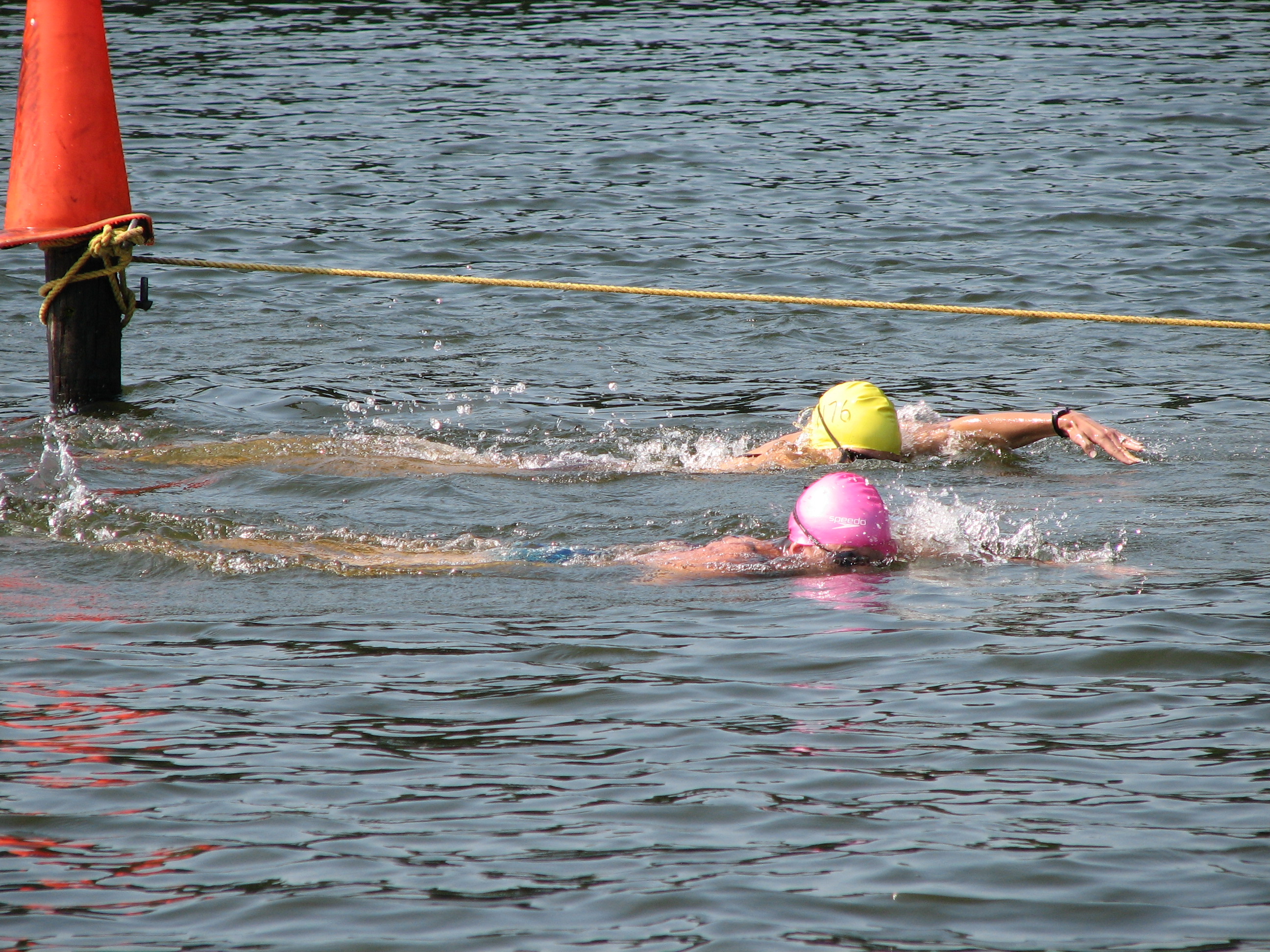
The swim consisted of four laps around a course marked by a cable stretched tautly between two wooden pylons. I wasn’t exactly sure how to pace the 2-mile swim, so I treated it as I would a timed 1,650 in the pool: I like to start at a moderate, steady pace, and step it up as the swim goes on. In retrospect, I could have maybe pushed harder on the second and third laps. But then again, I swam my heart out on the fourth one (I may or may not have grunted in the water), and finished feeling like I’d just done 900 tricep dips at the gym.

My time: 56:15. And though my age-group finish was a little disappointing, I was thrilled that I came in 29th overall out of the roughly 100 swimmers.

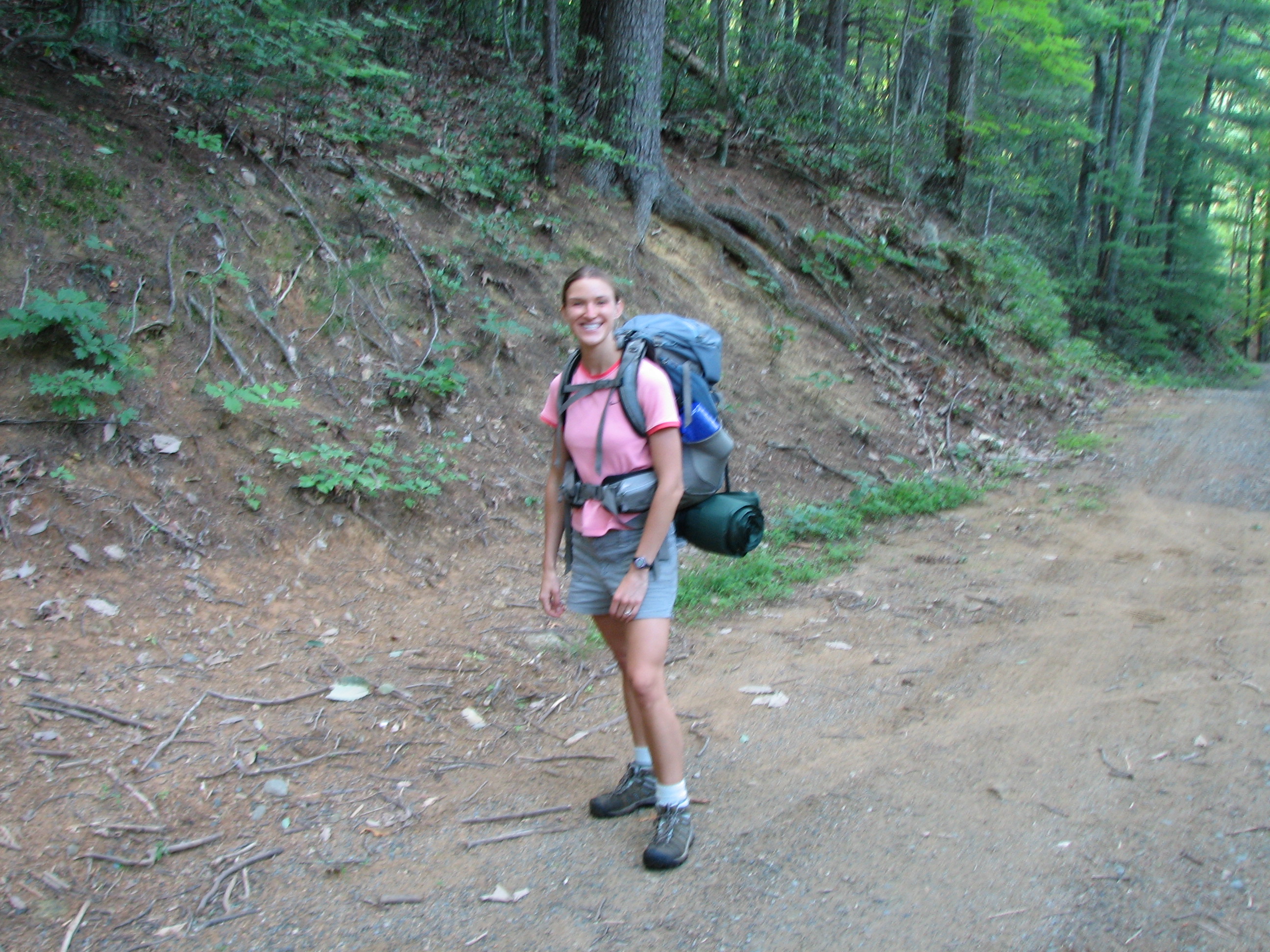
Even better: Charlottesville is close to Shenandoah National Park, so Steve and I made a quick side-trip to try out my beautiful, new suspension-frame backpack! The trip included about 9 miles of hiking (split up over two days) through a cool, green river valley next to the most scenic waterfalls you’ve ever seen, plus TWO black-bear sightings! In the second instance, we saw two cubs scamper up a tree with a speed that left our jaws hanging. When we saw a giant, black blob in the distance, we picked up our jaws and booked it out of the park — if the babies were that fast, we didn’t want to find out how quick mama was.

Next up, swimming wise: The possibility of the 5K Smith Mountain Open-Water Lake Swim Sept. 26. It’s another US Masters Swimming event, which means it would be the same uber-competitive field. Still, with the right attitude, I think it could be a lot of fun. I’ll think about this one, along with another in Wilmington, N.C. I’ll keep you posted.

.


14 Comments

Filed under Uncategorized

An exercise in motivation

Several weeks ago, on my ongoing journey to find the end of the Internet, I

Adding a few items to my running board made me feel all warm, fuzzy and motivated.

Adding a few items to my running board made me feel all warm, fuzzy and motivated.

found a fabulous active.com post co-written by sports psychologist Alison Arnold, a “mental toughness trainer” for a host of Olympic athletes. I gushed about it at length (see my post here), and vowed to be better about getting my mind in the right place before my workouts.

I was so jazzed about the realization that I could actually affect my performance through my thinking, I pitched a story on the topic to Running Times. Fast-forward a few more weeks, and this week, I got to pick Arnold’s brain about how a regular ol’ runner like me can harness motivation like a pro.

While compiling a list of tips for the story, I decided to try the techniques myself before an everyday training run. Just to see. Here’s how it went:

1. Identify negative thoughts. Arnold says negative thoughts can be sneaky. We know better than to tell ourselves we’re about to have a crappy workout. We’re more likely to make definitive statements about our performance:  “I always get tired around this point,” or “I always get hurt in the winter,” Arnold says. Letting your mind focus on pain that might be quite real – “My knee is killing me” – counts, too.

I thought about this, hard, and discovered I really never give myself a break from a barrage of sneaky negative thoughts. Regulars in the chaotic, crowded happy-hour that is my mind: My creaky, gimpy hip will prevent me from running the Marine Corps Marathon this year. I always fall behind when I try to chase the faster pace group. I’m a spazz who should be barred from trail-running to avoid injury to myself and others.

Sheesh. Maybe we should try a different bar.

2. Substitute positive thoughts – or at least neutral ones. Arnold says not to sweat it if positive, sunny thoughts don’t ring true at first, and suggests taking “one step up on the feel-good scale.”

My positive spins: My hip problems have made me a stronger runner and overall athlete thanks to months of physical therapy, and I can always defer the MCM registration til next year if necessary, focusing on the Philadelphia Half-Marathon, or even a swim event, this year instead. As for the pace group, I know most of our group-run routes, so if I fall behind, it’s not a big deal. And trying to keep up with people who are faster than me makes me a better runner, which is why I’m training to begin with.

3. Feed the positive thought with breathing, music and continued positive self-talk.

The self-talk was great on the spazzy-trails front, and I enjoyed my run SO much more when I just focused on running it! But it did little to ease my anxiety when the guys I was running with did, in fact, pull away from me on the route’s last hill. This led to the equivalent of a bar fight in my head, as competing thoughts exchanged sucker-punches. I eventually shut them up by reverting to a mental playlist including lots of Eminem, not even realizing I was following Arnold’s advice. A bonus: I caught up to the guys at a stoplight. Sweet!

4. Channel your passion. Every runner should have a long-term goal they’re passionate about and should remind themselves of that goal often. A runner training for Race for the Cure might repeat “cure” during speed workouts. A runner training for a marathon might hang a course map on the refrigerator, tape a motivational quote to the bathroom mirror or create a billboard with inspirational magazine cutouts and photos.

I already had a little bulletin board with an ad for the MCM, a colorful little graphic from a Runner’s World story titled “Why Do You Run?” and an awesome pencil-sketch from my husband wishing me luck before the National Half-Marathon. I added a few new photos, along with an ad for the Crystal City Twilighter 5K, July 25, heeding Arnold’s advice about also having short-term goals.

4. Develop a pre-run ritual. Do the same stretches, listen to the same music and repeat the same few phrases that make you feel ready to run.  Use your breath to channel those feelings: Literally, imagine breathing them in.

How did I want to feel during my run? Powerful. Strong. Focused. In control of my thoughts. Like an awesome, uninjured, outdoorsy trail-running diva. I imagined breathing these thoughts in. Not much happened after, but maybe I just blew a fuse with the outdoorsy-diva bit.

For me, the major light-bulb moment was identifying all the sneaky negative thoughts competing for space in my mind. Picking them out and drowning them out definitely led to a happier — and faster — run.

Check out our awesome trail-run route here: Valley Trail loop through Rock Creek Park.

In other news: My appointment with my running doc this morning confirmed my suspicion that the Marine Corps Marathon might be out of the question this year. He said based on my hip’s history, I should spend the rest of July running 4 to 6 miles three or four times a week — no long runs, as my training plan calls for. Then again, he said, the MCM isn’t out of the question — I’m not benched, just questionable. In August, I can start adding long runs … and see how it goes.

The cool thing about seeing a doctor who runs: He asked if I had a time goal in mind. I said I did. He winced, and asked what it was, and what I’ve done before. I told him I wanted to come in around four hours, and said I ran a 1:49 half-marathon in March. “Oh!” he said, swatting his hand and smiling. “You should be able to come in under four hours, easy.” Thanks, doc!

Next up: the 2-mile Chris Greene Lake Cable Swim in Charlottesville, Va., tomorrow! I’ll be Tweeting from the race, and promise to have a post-race report up just as soon as we’re home — but with a planned side-trip to the Shenandoah, it might be a while. 🙂

10 Comments

Filed under Uncategorized

Recovery swim

I’m not doing a full-blown taper for the 2-mile Chris Greene Lake Cable Swim in Charlottesville, Va. on Saturday. I’m actually running a bit harder than usual, to see how my hip does with some tempo runs before my appointment with my running doc tomorrow.Tonight, that means the 5-ish-mile beach loop/hill run with Pacers, which involves running on my beloved Rock Creek Park trails before heading to what I’m sure will be some brutal hills.

That said, I am easing up a bit as the week goes on, nixing the core work I recently added to my repertoire. Considering my glutes are still screeching at me after a stability-ball workout on Sunday, I think this is a wise call. I’m also declaring tomorrow an off-day, and put in a nice, easy swim yesterday.

Here’s the lovely, sprint-free recovery workout, which included just enough hard effort to give me a pre-race ego boost, yet not enough to wear me out. I’ve been really into 800s lately, ever since Megan Killian (check out her training blog here) recommended a workout including a set of them. Do three of those bad boys, and wham! You’re almost done with your workout! If they’re too hard, you can back off on the speed — you get brownie points just for swimming the distance. If they’re getting boring, you can step things up a bit by inserting several hard strokes each 50.

3X 800 free w/pull buoy; first one easy, second one harder, third one w/seven hard strokes at the beginning of each 50

After each 800, do a 200 IM; first one hard, second one easier, third one cool-down.

2 Comments

Filed under Uncategorized