Monthly Archives: June 2011

Do the thing you think you cannot do

On Tuesday, I passed my five-month anniversary since ACL-reconstruction surgery Jan. 28 after tearing my ACL in early January, which means I’m officially re-released into the wild, and can twist, turn and otherwise play to my heart’s content. On Friday, I fly to Colorado for a family reunion. On the Fourth of July, I may go skiing.

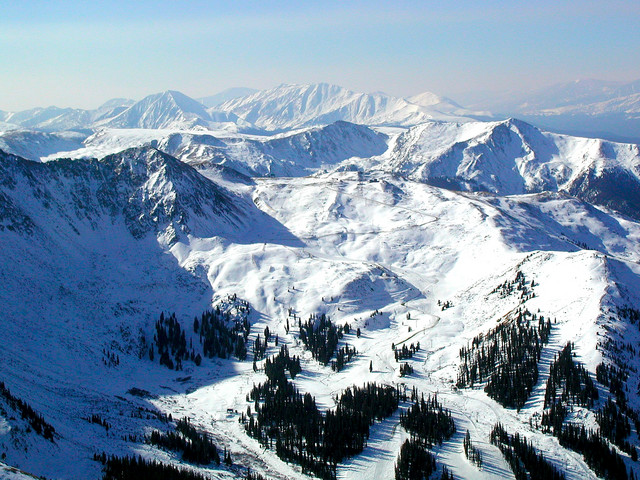
I may be skiing here, at Arapahoe Basin, on the Fourth of July. Seriously.

That’s right—skiing. Like, on snow. Arapahoe Basin, one of my favorite ski resorts in the world, is open until the Fourth, and if it works out with our family obligations (this is a rather large “if”), we’re planning to spend the morning skiing. Clearly, I’m terrified. I’ve spent months avoiding this exact kind of motion.  But I’ve worked hard in physical therapy to get over my hang-ups about using my poor, banged-up knee again, and I’m going to make like Eleanor Roosevelt and do the thing I think I cannot do.

I won’t be posting Friday, thanks to the aforementioned travel plans. Have a wonderful holiday weekend!

1 Comment

Filed under Uncategorized

Motivation Monday: Create your own adventure run

I have a confession: I’m maybe the only runner in the world who’s not into those adventure races. You know the ones I’m talking about—the ones whose courses have you run over some large, wooden obstacle course, through a man-made mud pit and maybe even over a fire, after which you are rewarded with a fuzzy Viking helmet and a turkey leg.

I know I’m in the minority here, and I’m not judging anyone for their love of man-made mud pits and fuzzy Viking helmets. I’m just saying that it’s not for me, and my trip to the Monongahela National Forest last weekend reminded me why that is.

We went to the Cranberry Wilderness Area, which is essentially one big bog. That means the ground beneath us was soggy and mucky—not because someone filled a pit with mud, but because a glacier created a cool little microenvironment when it plowed through thousands of years ago.

We didn't stomp through this particular bit of soil/peat, as it was within a protected area. But it gives you an idea of the conditions.

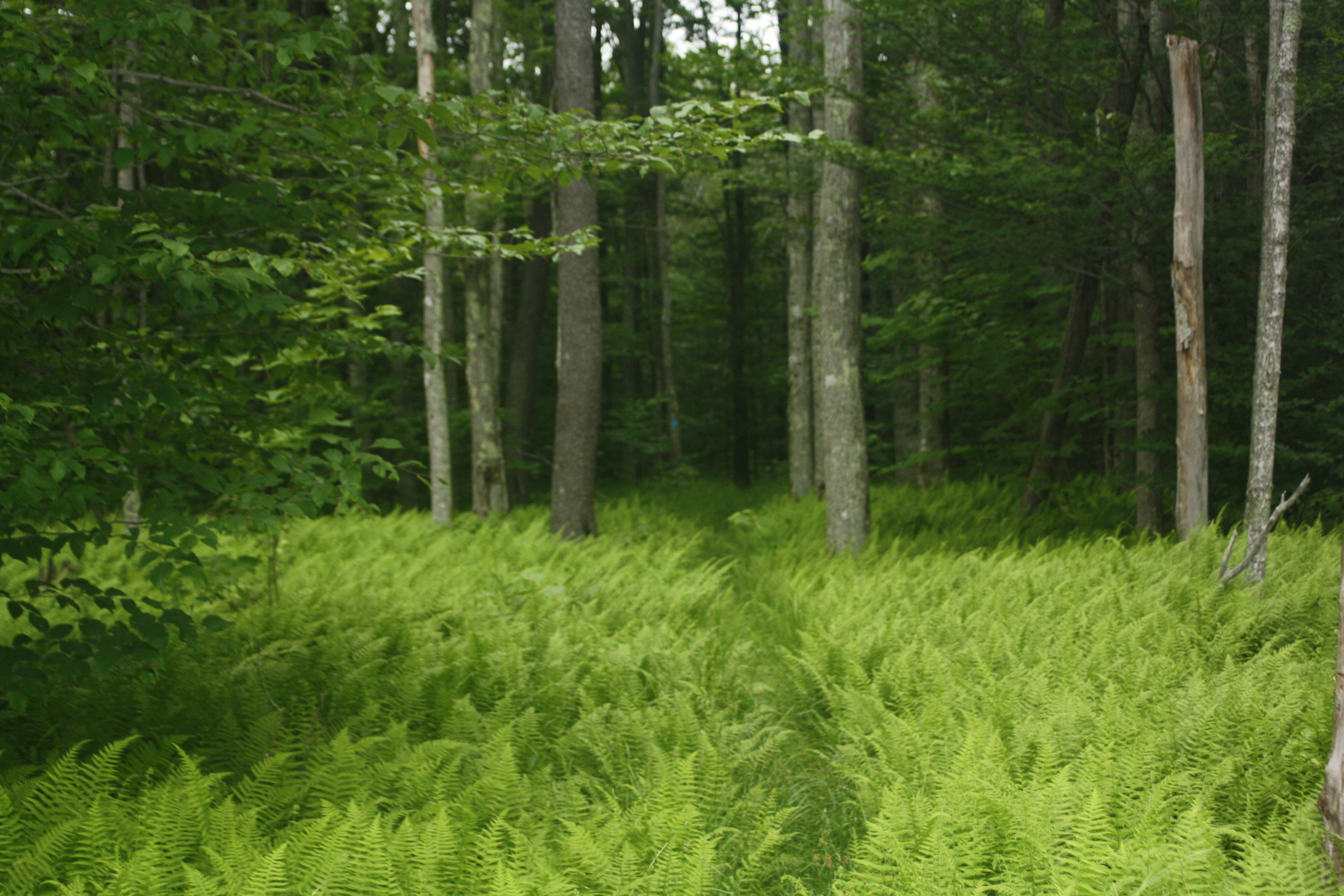
We hiked through seas of ferns and spruces that made us feel like we were in a northwestern rain forest rather than a West Virginia bog.

Brilliant-green ferns brushed our ankles throughout our trip through the Cranberry Wilderness Area of the Monongahela National Forest.

We sidestepped our own version of those wooden obstacle courses in the form of falling-apart footbridges.

Falling-apart footbridge in the Monongahela National Forest.

On our route, there were two spectacularly dangerous footbridges to hike around—which meant “fording” the small streams the bridges went over.

This photo is totally out of focus, but you get the idea.

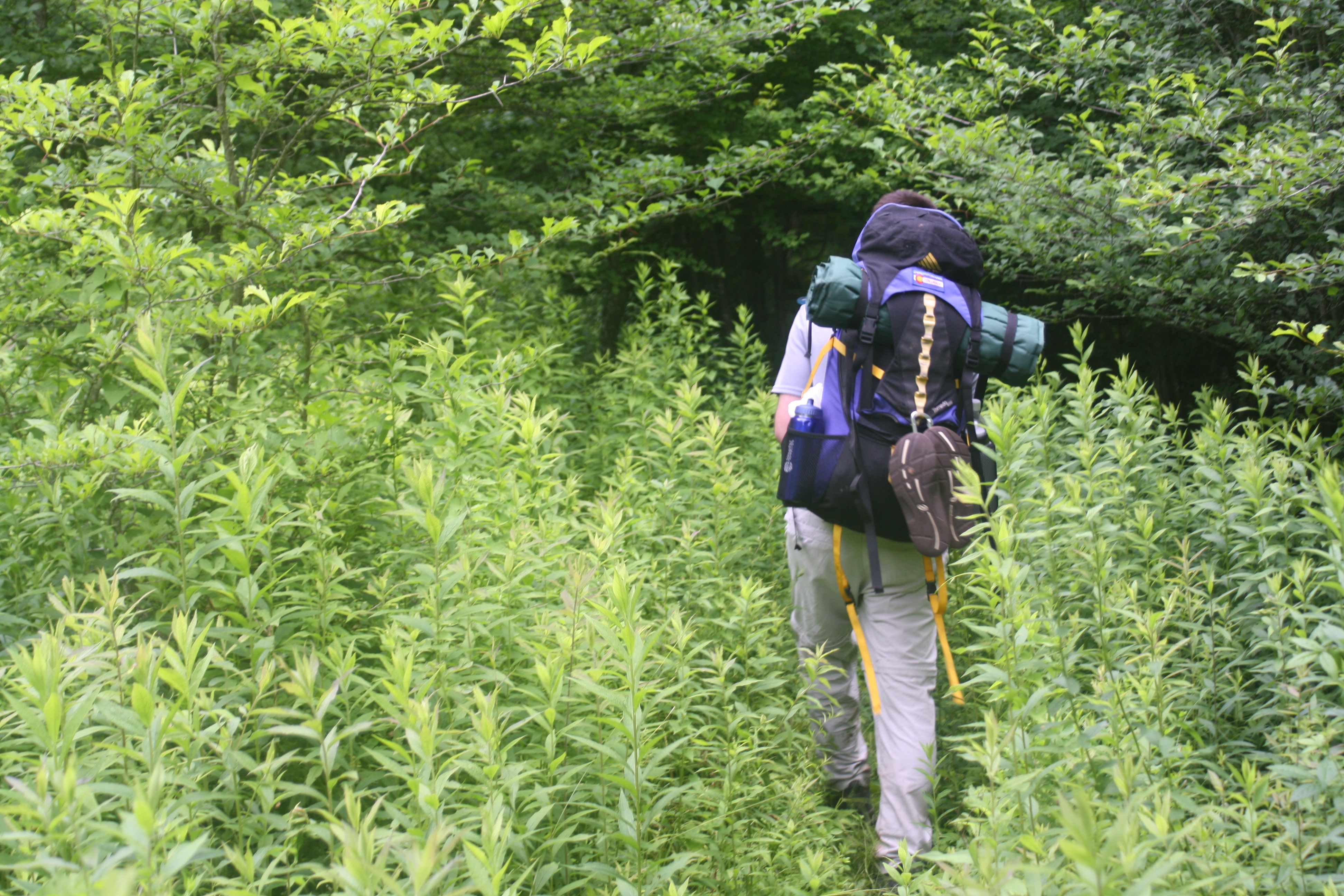
We even fought our way through tall grasses when our path carried us through overgrown meadows.

This was actually really hard work!

We were rewarded with the peace and solitude that only comes from not seeing another soul for 24 hours or more …

Spruce forest in the Cranberry Wilderness Area of the Monongahela National Forest.

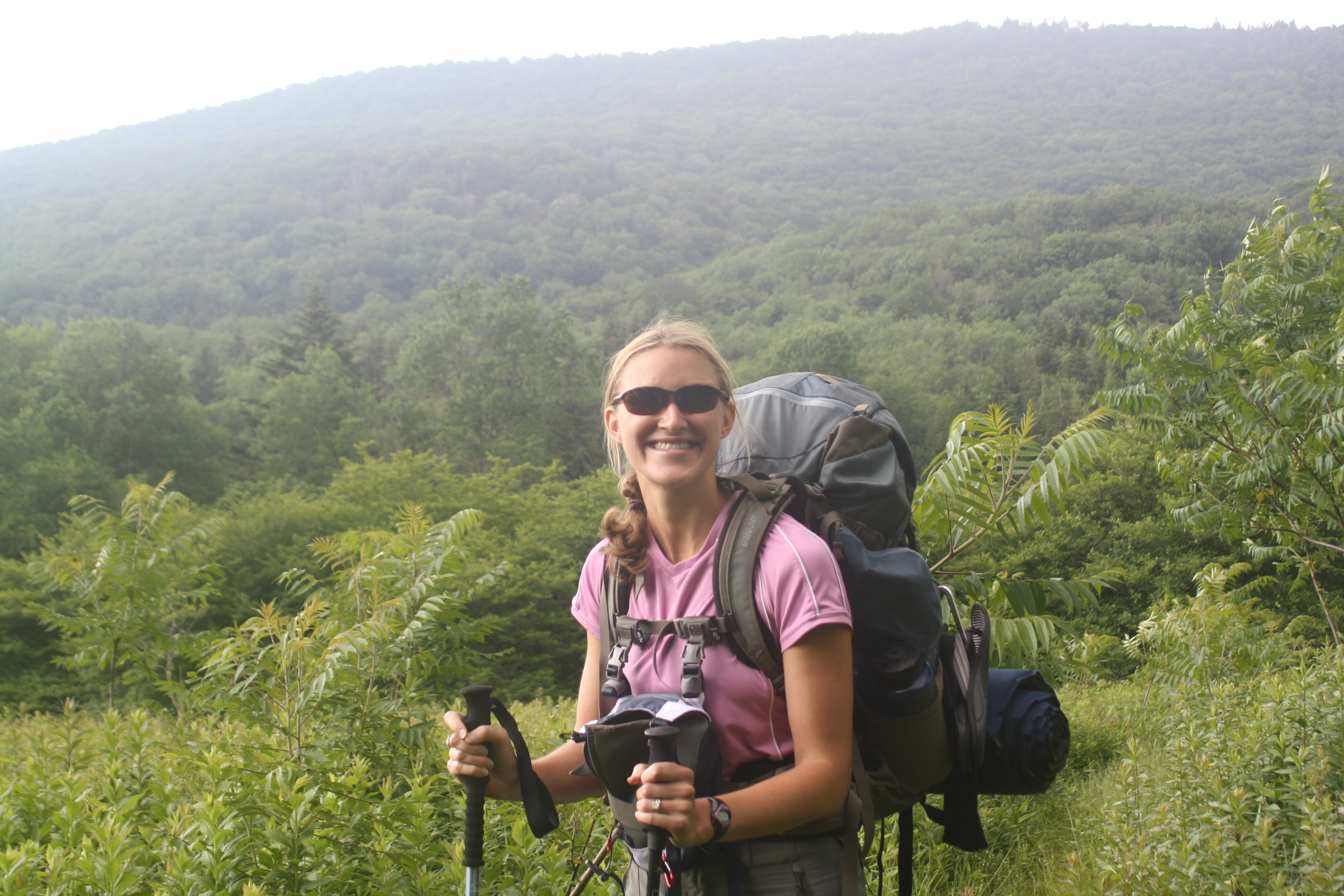
… and with some stunning vistas.

Pictured: Me, and gentle rolling hills in the Cranberry Wilderness Area of the Monongahela National Forest.

We finished the three-day, two-night trek covered with mud, and full of peace—a prize I’d choose over a fuzzy Viking helmet any day.

What’s motivating you this week?

3 Comments

Filed under Uncategorized

Into the woods

Monday marks my five-month anniversary of ACL reconstruction surgery, meaning I can now pivot, ski, hike and bike to my heart’s content. I feel there’s no better way to celebrate than with a (doctor-approved!) three-day, 20-mile backpacking trip in the Monongahela National Forest in West Virginia. Early July deadline for the story about it+July Fourth travel plans=gotta go now. Wish me luck, and stay tuned for some great stories and photos on Monday!

3 Comments

Filed under Uncategorized

Runner-friendly recipe: Crisp rosemary whole-wheat flatbread

Last weekend, while enjoying a lovely home-cooked meal at a friend’s house, I found what I’ll likely refer to as my favorite bread recipe for the next year or so. She served this lovely flatbread with feta cheese and wine on her back porch, and after my first bite, I basically pointed to the bread and asked how I could make it happen in my kitchen. Happily, it’s super-easy, and I’m including it here for experienced bread-bakers and yeast-o-phobes alike.

I’ve been meaning to try making flatbread ever since stumbling across Mark Bittman’s whole-wheat take on it several months ago. My friend’s recipe comes courtesy of the excellent cooking blog Smitten Kitchen, courtesy of Gourmet magazine, and I doctored it only slightly, using half whole-wheat flour in place of the white flour. I can confirm that both versions were totally terrific.

Crisp Rosemary Flatbread
Adapted from Smitten Kitchen, which adapted it from Gourmet, July 2008

1 3/4 cups unbleached all-purpose flour (I subbed a cup of whole-wheat flour for some of this, and it turned out great)
1 tablespoon chopped rosemary
1 teaspoon baking powder
3/4 teaspoon salt
1/2 cup water
1/3 cup olive oil plus more for brushing
Sea salt

Preheat oven to 450°F with a heavy baking sheet on rack in middle.

Stir together flour, chopped rosemary, baking powder, and salt in a medium bowl. Make a well in center, then add water and oil and gradually stir into flour with a wooden spoon until a dough forms. Knead dough gently on a work surface 4 or 5 times.

Divide dough into 3 pieces and roll out 1 piece (keep remaining pieces covered with plastic wrap) on a sheet of parchment paper (I used tinfoil, and it turned out fine) into a 10-inch round (shape can be rustic; dough should be thin).

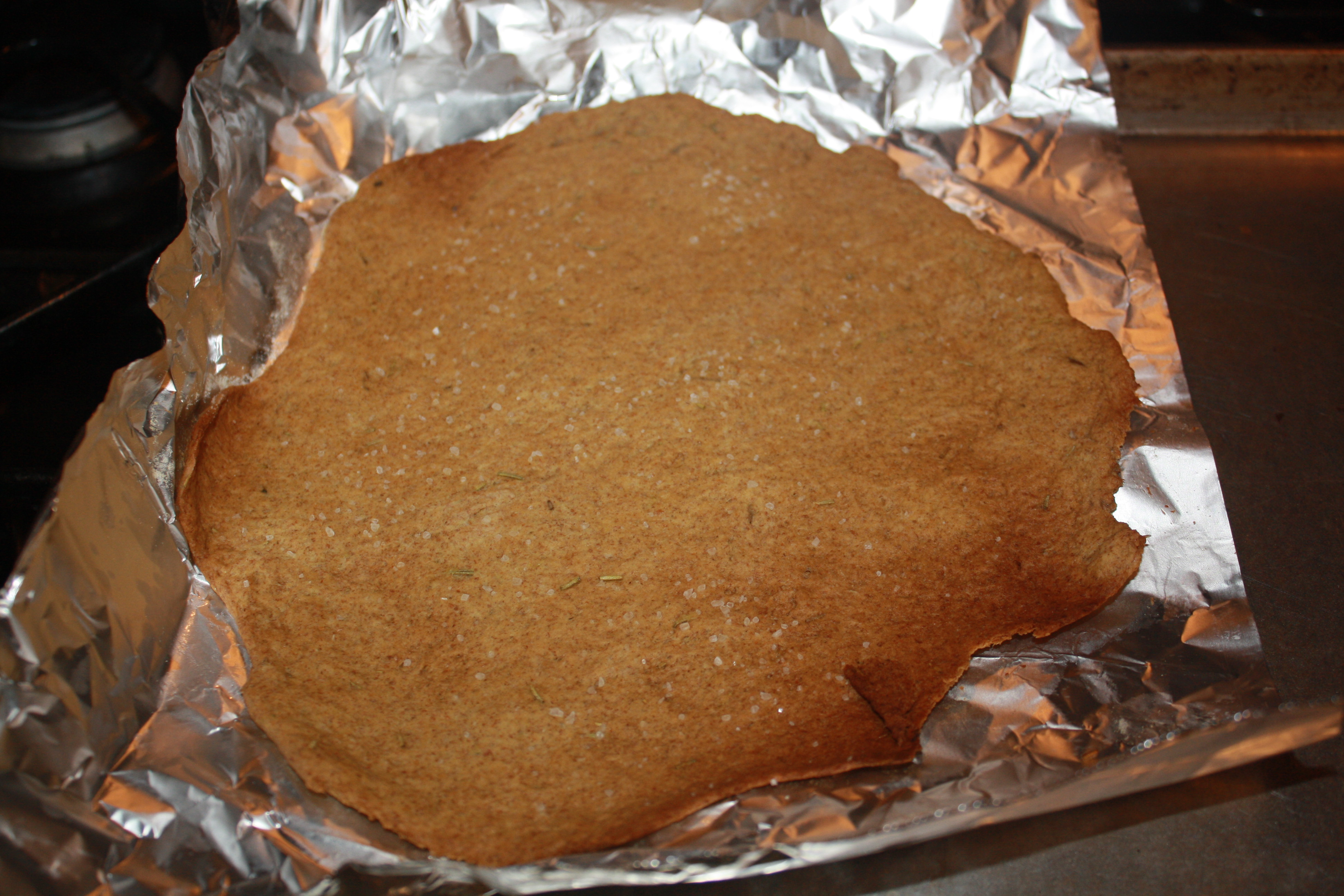
Lightly brush top with additional oil. Sprinkle with sea salt. Slide round (still on parchment) onto preheated baking sheet and bake until pale golden and browned in spots, 8 to 10 minutes. Transfer flatbread (discard parchment) to a rack to cool, then make 2 more rounds (1 at a time) on fresh parchment (do not oil or salt until just before baking). Break into pieces.

Flatbread can be made 2 days ahead and cooled completely, then kept in an airtight container at room temperature.

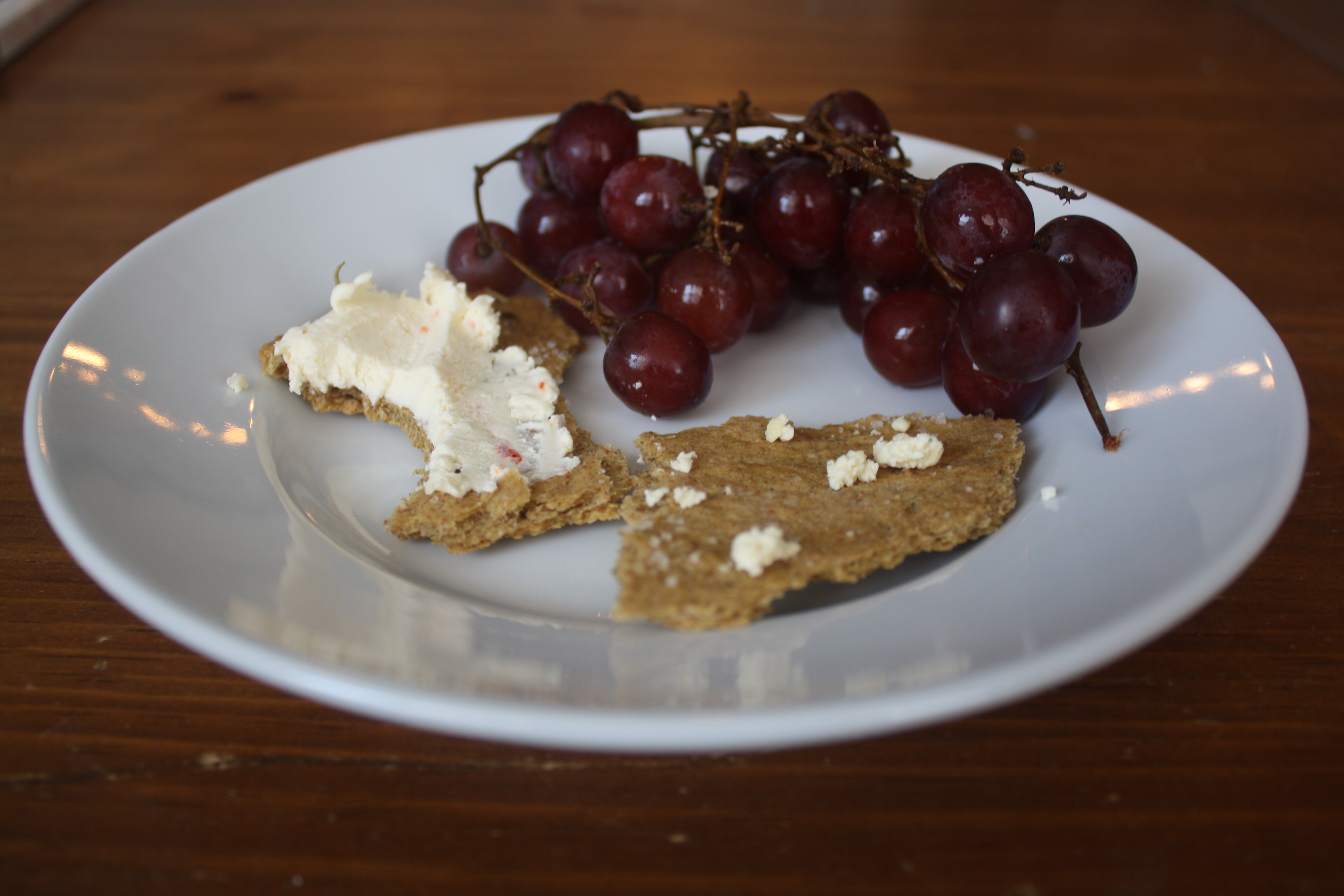
I enjoyed mine slathered with a soft cheese called “quark,” which I purchased at the Takoma Park farmer’s market last weekend. The placard advertising the cheese said it’s a traditional, European farmhouse cheese that many Europeans ate daily for its supposed health benefits. That’s why I ate it—for health.

In other news, I will never again joke that my primary goal for the 4.4-mile Great Chesapeake Bay Swim is, “don’t die,” after reading that a swimmer did, in fact, die in the water that day. Check out the full report in The (Easton, Md.) Star Democrat (ironically, the first paper I worked for), and the Washington Post obituary—I got the chills reading both, and have been thinking about C. Grahame Rice and his family ever since.

1 Comment

Filed under Uncategorized

Motivation Monday: The ‘advance planning’ edition

I typically pride myself on remaining flexible about race registrations. I like to feel ready and able to jump into an event at the last minute if it sounds interesting, fun or rewarding. But a case of goal overload leading up to the Bolder Boulder 10K and the 4.4-mile Great Chesapeake Bay Bridge Swim has led me do a bit of advance planning for my races over the next few months, so I don’t feel such a crunch to train for more than one biggie at the same time. And guess what? It’s actually pretty motivating to write some race dates on the calendar *before* the calendar fills with other obligations (Full disclosure: Yes, these dates are written in pencil.).

Rockville Rotary Twilight Runfest 8K 8:45 p.m. July 16. And it’s only $31 through June 30!

Daiquiri Deck Tropical Splash 5K swim, Sarasota Fla. 7:30 a.m. Oct 1. (No race website, but you can download information here.)

Finishing the Daiquiri Deck Tropical Splash last year.

Philadelphia Half Marathon.  Nov. 20.

Finish the ski-patrol training I had to postpone after an ACL tear: Not a race, but certainly a commitment that will take up some physical energy in December.

Yuengling Shamrock Half Marathon. Virginia Beach, Va. March 17, 2012.

Great Chesapeake Bay Bridge Swim. June 2012.

Finishing the Great Chesapeake Bay Bridge Swim this year. And yet, I'm still anxious to do the swim again next year.

What’s motivating you this week?

7 Comments

Filed under Uncategorized

Great Chesapeake Bay Swim: Lessons learned

A few years ago, The Onion ran an infographic titled “chat room shorthand.” It included this acronym: NTBUSWAB, which stands for Not to bring up Star Wars again, but … (it also includes 18/F/NYC = Pockmarked 46-year-old in bathrobe; and WSTS = Weeping silently to self).

So. NTBUTGCBSAB …

This partially aims to serve as a note to myself for future years (Yes, I am planning on doing that crazy business all over again next year. Every year. Like some weird, masochistic anniversary with myself.). It’s partially so others attempting the swim in the future can learn from my mistakes, so they don’t make the same ones.

If you swim three times per week, with one of those being a long swim, you will finish. I realized pretty early on that in order to finish this swim quickly, I’d have to swim a heck of a lot more meters per week than I was currently pulling. So I decided to train to finish, and I did. I only swam three times a week—sometimes two—and averaged about 12,000 meters per week, maximum. The other days, I ran, or focused on physical therapy for my ACL. I’ll likely approach the swim the same way next year.

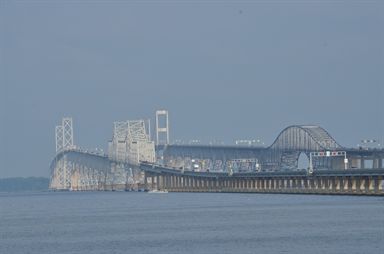
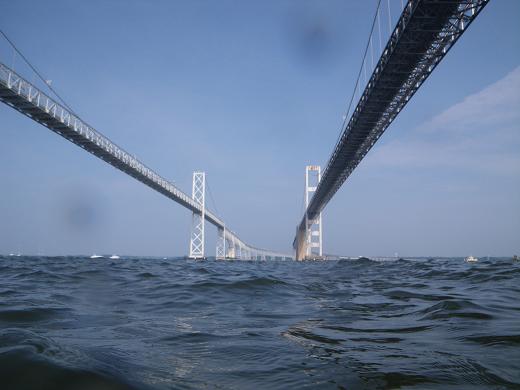
Long swims helped me get ready to swim the length of this bridge.

Build confidence with long swims. 4.4 miles equals roughly 7,000 meters. My go-to long-swim workout: 7  X 1,000 meters, with each 1,000 as evenly paced as possible. There’s nothing like covering the exact distance of the swim to build confidence that you can, in fact, swim that distance in the open water.

But know that it’s not about the distance. Or even the chop. For me, the biggest challenge was the tide. I’d like to think that I’ll find a way to prepare for that next year, though I have no idea how. For others: Just know that if there’s a way to practice swimming against a current that strong, it would be a reeeally good idea to make that happen.

Honor thy shoulders. As soon as my shoulders recover from this swim, I’m going to start strengthening my rotator cuffs for next year. Waiting until I’d started my long swims—i.e., once my shoulders were already hurting and making alarming snap-crackle=popping noises—was a mistake, and I was lucky to get away with that. I recognize that things might be a bit easier when I can use my legs for more than the last three weeks of training (no ACL tears next year, please).

I'm glad this moment wasn't my first in the open water this year.

Test yourself in the open water. During my training, I stumbled across a terrific post-race report from the 2010 swim from Rob at RobAquatics.com. I emailed Rob to ask for any last-minute training advice, and he suggested getting out into the open water shortly before the race, if I hadn’t done so this season. I had finished a 5K swim in the Gulf of Mexico in October—surely that was enough? Nope. Getting the feel for “sighting” (looking forward to spot landmarks in the distance to ensure you’re swimming straight) and breathing in chop was invaluable. Squirming into my wetsuit and testing my stuff in a Bay tributary a couple weeks before the race was a huge confidence booster! So was a reminder from Bay veteran Al Gruber’s pre-race report:Your wetsuit always fit better last year. Ha!

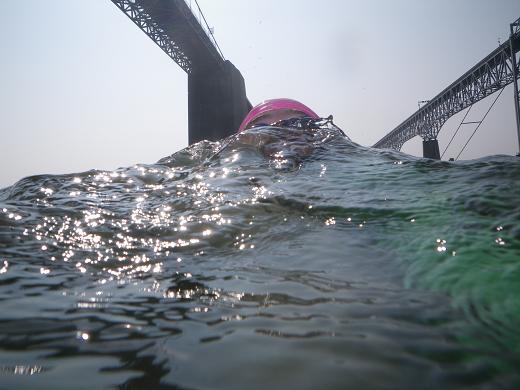
Mid-race self portrait courtesy of Rob Dumouchel of RobAquatics.com.

Mental toughness is paramount; practice this during long swims, and after traumatic injuries. I know what you’re thinking: But she tore her ACL, and therefore had all this extra practice in not getting inside her own head and being all crazy in the middle of a tough physical endeavor! Lucky! In all seriousness, I’m more proud of my mental toughness during this race than anything else. I got all the crazies out during a few early long swims, during which I realized that your head game can go south pretty quickly when your head is underwater. In the training swims leading up to last Sunday, I learned to love the meditative stillness of swimming again, and to settle into a relaxed pace for long periods of time. I also learned how to come back to that relaxed pace after something throws me off. During the swim, lots of stuff threw me off—but I simply acknowledged the condition, and then kept swimming.

And finally, plan to be worthless the Monday after the race. This race is less like other open-water swims I’ve done and more like a marathon. Your body will need to rest and repair itself, so build in some time to allow that to happen.

Make sure you check out what other Bay swimmers have had to say about the race: Read Donna’s post-race musings here, and Amy’s here.

Did you do the swim? What’s your biggest takeaway? Maybe I can learn from your mistakes!

2 Comments

Filed under Uncategorized

Wordless Thursday: Great Chesapeake Bay Swim finish-line photo

I foreshadowed this unbelievable finish-line photo in my Great Chesapeake Bay Swim race report yesterday. Still, I’m pretty sure you weren’t expecting *this.* My only consolation: Unlike the poor dude behind me, I was, in fact, able to stand up.

Caption contest, anyone?

5 Comments

Filed under Uncategorized

Race report: 2011 Great Chesapeake Bay Swim

(Editor’s note: I know this is long, but I wanted to offer as comprehensive a report as possible for people prepping for the race next year, since others’ post-race reports were such a help to me this year. If you don’t plan to do the swim yourself, feel free to skim.)

Crossing the finish line of any race is a jubilant experience. No matter how hard the race itself was, the idea that it’s done, and the visual representation of what you just accomplished, is usually enough to inspire one last rally to finish strong. That’s especially true of open-water swims, with their added drama of rising from the water and running onto land again. That makes for one awesome finish-line photo (throw in a wetsuit and you look and feel like a superhero).

Me finishing the 1-Mile Chesapeake Bay Bridge Challenge in 2009. I did *not* look like this on Sunday.

The finish line of the 4.4-mile Great Chesapeake Bay Swim—and the swim itself—was different from any other event I’ve participated in. In the final yards of the race, I kept waiting for the surge of adrenalin that would power my exhausted body across the finish line. It never came. Instead, I stumbled onto shore, with my only goal being not falling flat on my face. “Take your time,” a volunteer said cheerfully as I tried to steady my wobbly legs. My timing chip was removed. My wetsuit was unzipped. My bib, tucked beneath my cap, was taken. When I finally looked around, I noticed that I was in good company, with several other wetsuit-clad zombies shuffling away from the shoreline—this is not a race that leaves you with the energy to run.

My preparation started the day before, when I spent the morning kneading and baking homemade pita bread and pizza dough, and the afternoon and evening hosting a movie-marathon/pizza party (a ploy to get a bunch of friends to come over and help keep me sane).
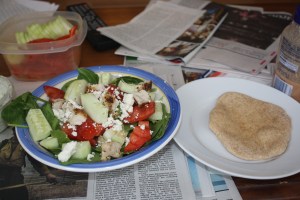
Taper crazies=homemade pita bread=delicious lunch.

The next morning, Steve and I arrived at Sandy Point State Park at about 9:30 a.m., leaving me plenty of time to apply Bullfrog sunblock, BodyGlide and PAM cooking spray to prevent sunburn and chafing.

Two dear friends from my running group came to the race to support me, for which I’ll be eternally grateful. In return, I entertained them with the PAM application and strange dance that comes with putting on a wetsuit.
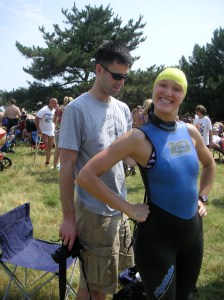
At the pre-race meeting, race director Chuck Nabit told us the rules: No straying beyond the two spans of the bridge. No removing your cap. Feel free to grab the side of one of the “snack boats,” or boats equipped with water and munchies like Nilla Wafers. If you feel like you want to quit, just ring the bell three times. Oh, wait—wrong movie. If you want to quit, let a support boat know, and the boat will take you to the DNF pier. No joke—there’s a DNF pier. During this meeting, Nabit described the ebb tide we’d feel at the beginning of the race as “gentle.”

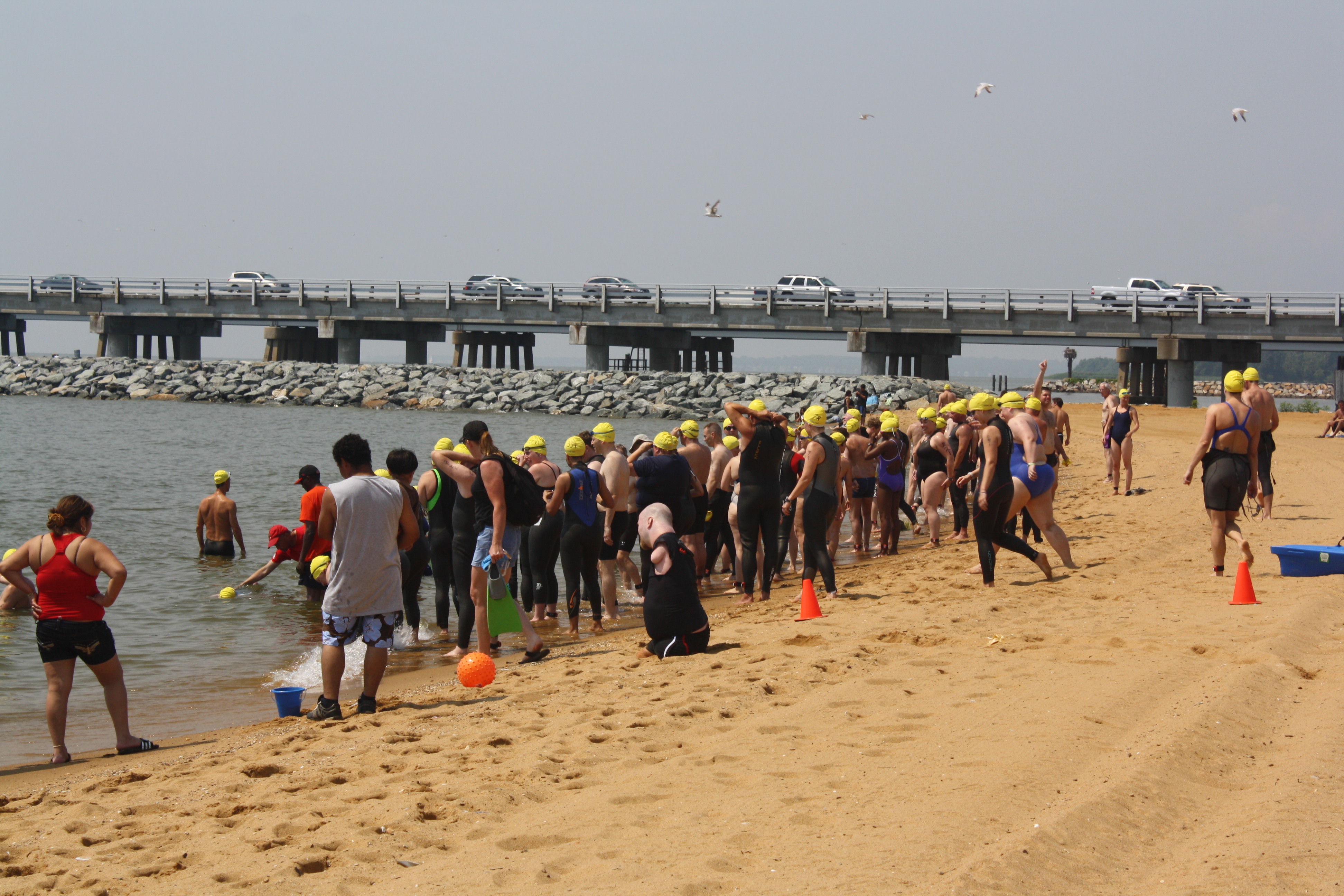
After the first wave—slower swimmers and rookies donning yellow caps, to include me—was called to the starting corral, we waited what seemed like forever on the hot sand in our hot wetsuits, stewing in the hot air and complaining about being—well, hot. Seeing the guy who was born without arms and legs start the race moments before we did made us quit our complaining. And then it began.

The “Cuisinart start” (known as such because it feels like you’re getting chopped up by a mass of churning arms and legs) wasn’t too intense. But as I noted on Monday, it lasted the entire first mile, as the lead pack in my (slower) wave stayed in a tight clump until we crossed beneath the northern span of the bridge. I’m still amazed at how talented and well-trained this group of swimmers were, and totally understand why U.S.A. Swimming named the Great Chesapeake Bay Swim among the world’s most competitive open-water swims. A few impressions from throughout the course:

Mile marker 1: I feel fantastic, and am relishing the familiar rhythm of the open-water swim, taking long, smooth strokes through the brackish water. I’m exactly the right temperature in my wetsuit. Nothing is chafing. Nothing is sore. I flip on my back and glance at my watch when I spot the first mile marker: 23 minutes. I am going to SMOKE this thing. Screw finishing below two and a half hours—I can crank this baby out in an hour and a half! Happily, I don’t feel a bit of the gentle ebb tide Nabit mentioned.

Shortly after mile marker 1: Here’s the thing about that tide: You don’t feel a pull so much as you suddenly find yourself just a few meters away from the concrete base of the southern span. Which is a really, really unpleasant realization.
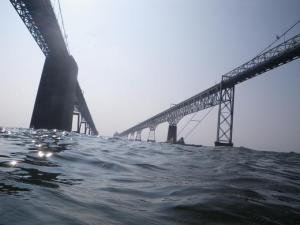
Photo courtesy of RobAquatics.com.

About 1.5 miles: I veer to the left to get back on track, and keep my body angled slightly to my left to counteract the southward pull of the tide—no luck. I’d have to swim at a 45-degree angle to swim straight—that can’t be right. I crane my neck to spot a landmark to “sight,” and notice two other women swimming with short, choppy strokes, like they’ve been caught in a rip tide. Crap. I adjust a little farther to the left, and console myself by noting that this is hard for everyone, not just me. I ponder adjusting even farther to the left, but convince myself that I’m imagining how extreme the tide is. I don’t readjust until the first of the faster, second-wave swimmers, who are wearing red caps, pass me, and I notice that their bodies are perpendicular to the spans of the bridge, swimming at a 45-degree angle to travel straight. I follow suit, keeping my eye on short-term markers to prove that I am, in fact, moving forward, and not just swimming in place. I instantly regret wasting so much time not trusting my instinct.

Mile marker 2: The coveted snack boat is directly in front of me. I didn’t train with any mid-swim nutrition, so I don’t take any of the food, just a Dixie cup of water. My main reason for stopping is not to eat, but to confirm that I’m not making up the insanity of this tide. I sputter some probably-unintelligible words to the other swimmers clinging to the boat for dear life. They concur. I keep swimming, maniacally singing “Three Little Birds” to myself to calm my panicked mind.

Shortly after mile marker 2: The tide calms as quickly as it started. I wonder again if I’ve made up its intensity. I feel euphoric as I settle in to the smooth, even strokes I’ve been practicing during long swims for the past several months. I pass at least three or four other swimmers, and congratulate myself on plowing through the chop—swells that looked to be about two or three feet. I repeat the mantra that got me through those long swims—stronger every stroke.

Photo courtesy of RobAquatics.com.

Somewhere between mile 2 and 3: Things are getting kinda weird out here. Awe fills my heart when I realize I’m in one of the main shipping channels for the Bay. I am in the middle of the Chesapeake Bay! Amazing! All my other open-water swims (loop courses, or courses along the shore) suddenly feel silly and pointless, the way running on a treadmill feels in comparison to trail-running. At the same time, my arms are completely wiped from that horrid second mile. There’s something weird going on between the end of my cap and the beginning of my wetsuit on the back of my neck. My back and neck ache from all the sighting during that second mile, and I wonder if it’s possible to break your back swimming. I recoil when my hand touches something squishy—a jellyfish? No. A dead fish. Ew. Ew. Ew. My body shudders involuntarily as I think about all the different reasons fish die in the Bay.

Still somewhere in the abyss between mile 2 and 3: I see the turkey buzzards Al Gruber, an experienced Bay swimmer who issues an annual pre-race report, said to look for in the lattice work near the second shipping channel. The second shipping channel! I’m in the second shipping channel!

Around the second span: I passed mile 3, right? Right? I’m not panicked anymore, just kind of curious, like the race is happening to someone else. “Stronger every stroke” doesn’t work when you feel like your back is broken, and my mantras take a turn for the random and nonsensical. I recently worked on a story about disordered eating among women runners for which I interviewed two experts in women’s sports medicine and dietetics, Dr. Carol Otis and Dr. Suzanne Girard Eberle, respectively. I found myself repeating mantras they use to encourage healthy eating habits for women athletes: Otis’ “too fit to quit” sounds great to the tune of “2 Legit 2 Quit.” (I’m too fit! I’m too fit to quit! He-ey-hey!) Eberle’s “strong body, strong mind” carried me most of the rest of the race, though I can find no reference to her saying that exact phrase now. I highly recommend it as a mantra, though, wherever it came from.

Mile 3: Everyone warned me not to get too excited about passing the second shipping channel, as there’s still more than a mile before the final stretch to the finish line. And that final stretch is still 700 yards, which is not nothing. Still, it’s hard not to get excited, and I try to pick up the pace a few times. I cue the mental Nicki Minaj soundtrack, and sing: “You play the back, (expletive)—I’m in the front” to myself as I try to pass a red-capped swimmer. He pulls away from me easily. OK, fine—I’ll take the back.

In the middle of mile 3: I wish desperately I’d forced myself to eat the banana I brought for pre-race fuel. At the same time, I feel a little nauseous, and taste the oatmeal and blueberries that have served me well throughout training. Something really bad is happening on the back of my neck.

Getting close to mile 4: I feel little pangs of pain throughout my body. As I shake out my legs to work out the cramps shooting through my calves, I feel a stinging sensation in my bad knee, and I convince myself I have screwed up my still-new ACL graft. My manta becomes the voice of my doctor sighing, rolling his eyes at me and and saying: “Yes, I *promise* you won’t hurt yourself kicking freestyle.”

The last 700 yards: The shore is ahead of me. I have traveled from one side of the Bay to the other. I am going to do this. I am going to get to that finish line. Could I have swam smarter and gone faster at mile 2? Yes. No. Doesn’t matter. Dig deep here. If there’s anything left, use it up here. I grunt audibly as I sprint for 10 or 20 strokes in a row, after which I audibly whimper in exhaustion, then repeat. The race isn’t finished, but I keep saying to myself: This was harder than I thought it would be. This would normally be what my friend Sarah calls the “guts and glory” portion of the race, during which I try to pass everyone in sight. I couldn’t care less about passing anyone, but am terrified of finishing with something left in the tank, of having come here and attempted this incredible race without giving it everything I had.

Last 50 yards: I am swimming alongside a woman who looks to be my age, and I decide I do care about passing. I pour my everything into the last 50 yards and stumble to the finish line ahead of her.

Post-race snack table: I can’t pull myself away from the orange wedges. To the amusement of the snack-table volunteers, I’ve repeatedly apologized for the number of orange wedges I’ve eaten (20? 30?), and yet I still can’t stop. I need to sit down. Would it be weird to sit on the table next to the oranges? I see my friends, and tell them to hold on, then stuff a few more orange wedges in my mouth. The sight and/or thought of all other food makes me want to vomit. I feel the back of my neck, and realize my cap and wetsuit have been playing tug-of-war with a tiny section of hair, leaving me with the most painful and most random chafing I’ve ever experienced.

I tear myself away from the oranges. I hug my friends. I kiss my Steve. I sit down on the grass. I realize sitting on the grass will not get me closer to food, or home, and I say something angry about needing food (that nausea passed reeeally quickly). My friends go ahead to Hemingway’s and order chicken flatbread so food is waiting for me. I order the best crab soup I have ever tasted, and crab nachos. I’m aware that I’m not talking quite right.
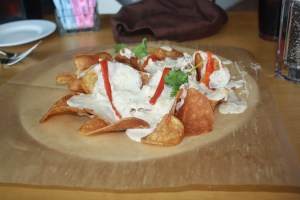
Once I’ve stuffed my face and start acting like a human again, my friends present me with the traveling trophy pictured below, named the Golden Pig of Awesomeness. A swimmer at a nearby table asks why he didn’t get one at the finish line. I tell him he’ll have to get friends like mine to snag one.

One friend asks if I’d do it again. The short answer: Yes.

STATS:

My time: 2:22:05, good for 13th out of 26 in my age group, 74th among the 180 women, 237 out of 542 overall.

620 swimmers entered the water at Sandy Point State Park.
78  swimmers did not finish
Of the 78 swimmers who did not finish:
16 were pulled prior to event interruption
62 were pulled thanks to the U.S. Coast Guard’s decision to halt the event based on the threat of an impending storm.

15 Comments

Filed under Uncategorized

Great Chesapeake Bay Swim recap, photos

I did it!

I finished the 4.4-mile Great Chesapeake Bay Swim in 2:22:05, good for 13th out of 26 in my age group, 74th among the 180 women, 237 out of 542 overall. I’ve done the 1-mile version twice, and placed in my age group each time. But in so many ways, for so many reasons, this was NOTHING like the 1-miler.

Watch for the full race report later this week. For now, a few observations, and some photos:

  • This was the hardest athletic event I’ve ever participated in. That includes several other open-water swims of distances up to 5K, and my two marathons, including one in which I suffered severe digestive difficulties. That means mentally and physically, since you had to adjust to changing conditions and expectations every few strokes, alternating between the euphoria of swimming long, smooth strokes beneath a monolithic feat of engineering and the frustration of spending an entire mile swimming at a 45-degree angle to go in a straight line against what was described by the race director as a “gentle” ebb tide. I never, ever want to experience a tide that is NOT gentle.
  • The people who sign up for this race are talented, well-trained swimmers. At the risk of sounding cocky, I’m used to being able to get out ahead of the “Cuisinart start” pretty quickly. Not the case yesterday. The lead pack of my wave (the slower of the two) stayed together for the entire first mile (which was a 23-minute breeze, by the way). So cool, and so humbling.
  • I’ve never done an open-water swim with such a sense of adventure. For most of the race, I’d lift up my head to sight, and realize my next marker was a shipping channel of the Chesapeake Bay, for goodness sake!
  • I’ve never felt LESS isolation during an open-water swim. Usually, there are long stretches when I’m all alone in the water. I was never farther than a few strokes away from another swimmer on Sunday. After that terrible second mile (did I mention how strong the tide was? And that I had to swim at a 45-degree angle to avoid getting sucked off the course? And that it took me 45 minutes? I did? Oh, OK), I stopped at a “snack boat” to get a Dixie cup of water and to commiserate with fellow swimmers—i.e., “That tide! 45 degrees! AmIright?AmIright?”

Now, a few photos:

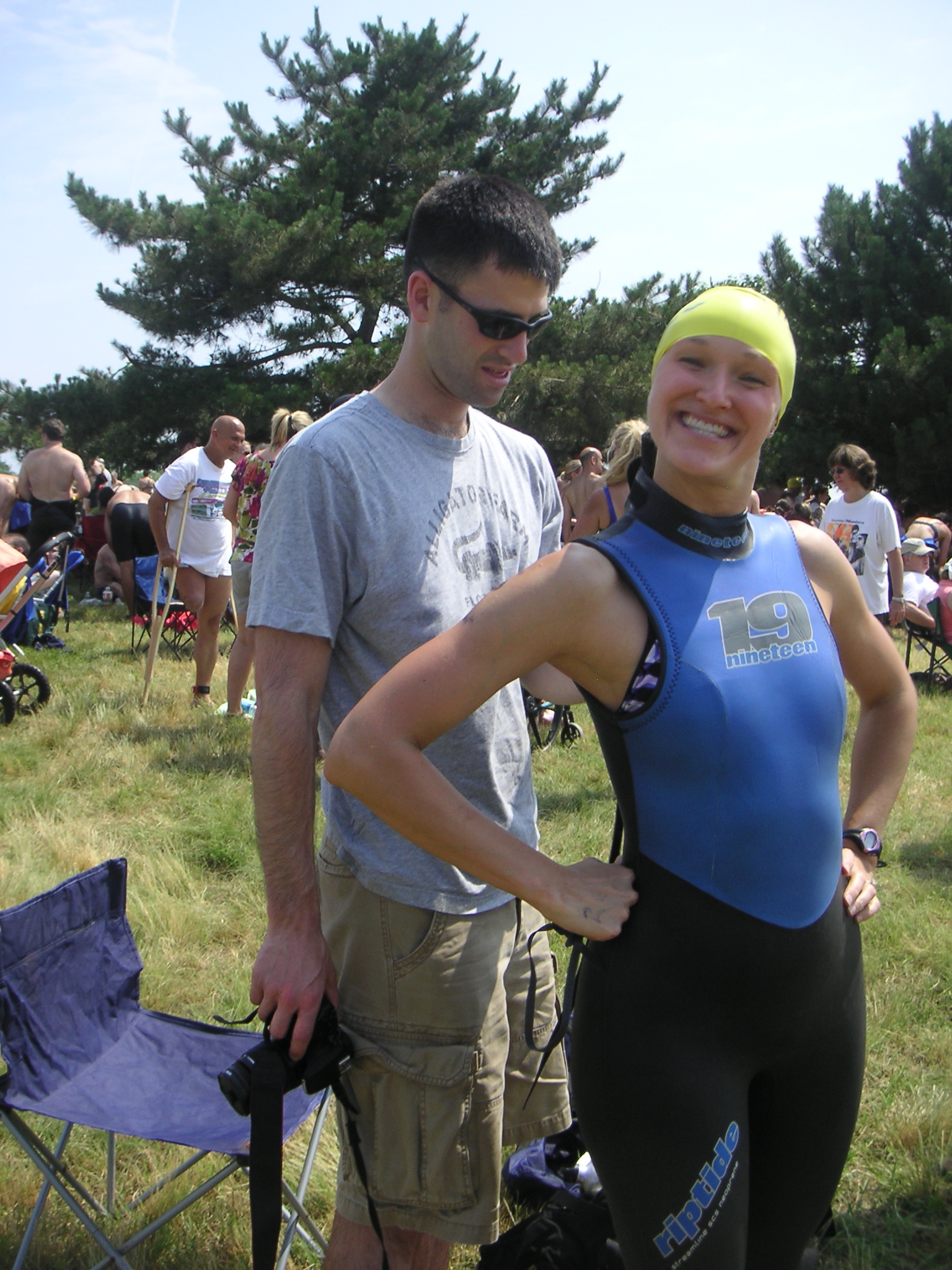
Steve assists with my wetsuit.

Donna and I are smiling because we still believe that bit about the "gentle" tide.

This wetsuit felt fabulous on dry land in 80-plus-degree weather. (Or not).

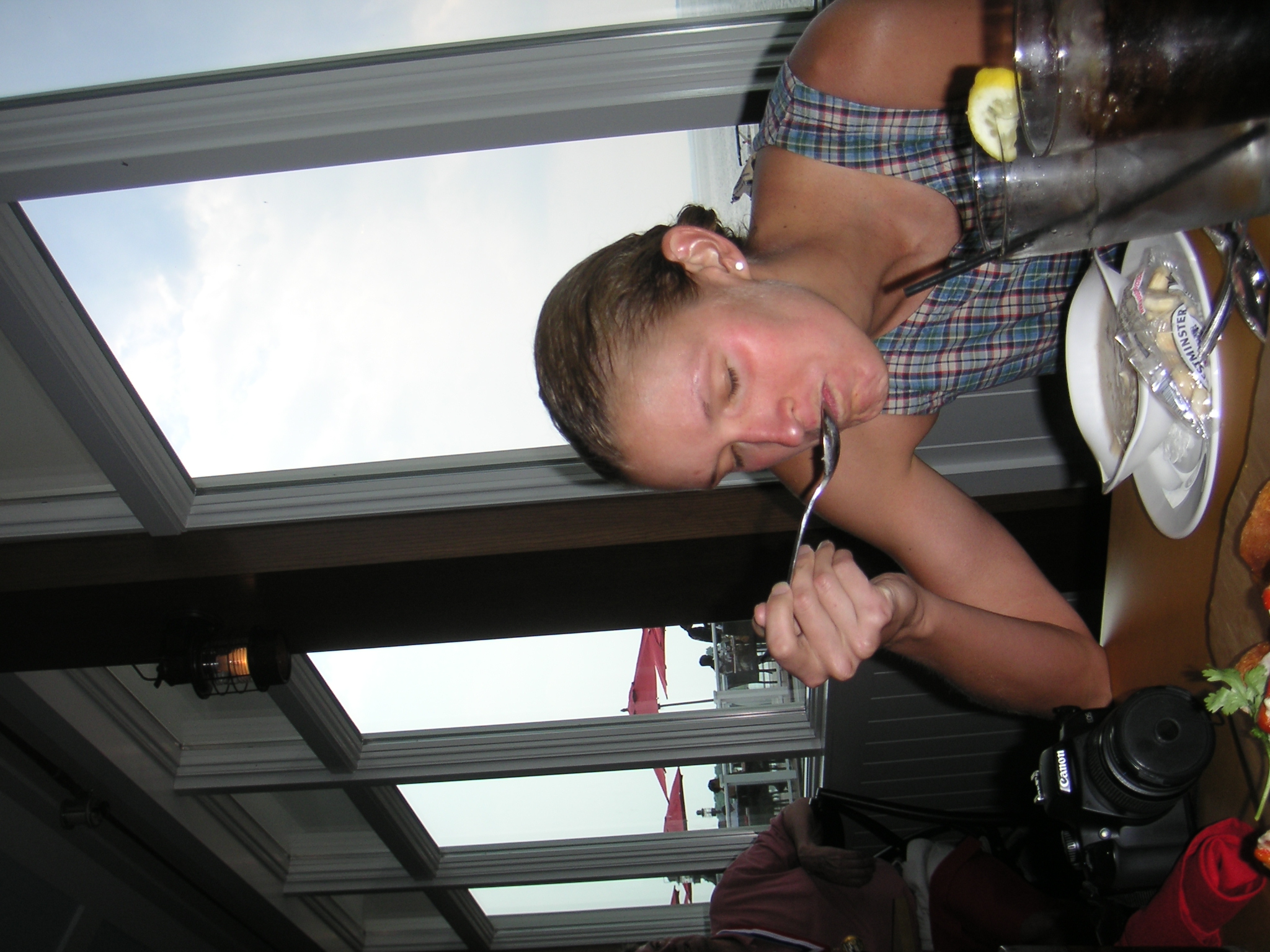
Post-swim meal of crab bisque at Hemingway's. Post-race-meal photos are usually jokey and smiley. I look like I might weep in this one.

15 Comments

Filed under Uncategorized

The plan: Great Chesapeake Bay Bridge Swim

It’s all over but the shouting. Erm, planning. And, technically, swimming. Whatever: The 4.4-mile Chesapeake Bay Bridge Swim is finally here!

I first seriously thought about signing up for the race back in October (see The Contemplation Phase), but I wasn’t sure I really wanted to do it until I realized I stood the chance of not getting chosen in the lottery in November (see Gunning for a BQ). So I pinned a printout of my favorite A. Aubrey Bodine photo of the bridge to my motivation board, and started training.

This gorgeous A. Aubrey Bodine photo has hung on my motivation board all winter.

Over the past several months, I’ve resisted training, thanks to my long-standing roller-coaster relationship with swimming (see How Swimming and I are like Ross and Rachel). But I’ve also embraced long swims of up to 7,000 meters, and have kind of fallen in love with swimming again, having realized that meditation and inner stillness are somehow easier for me while immersed in chlorinated water.

I’ve taken your great advice and planned what seems like the perfect race-day-eve on Saturday: Bake and/or knead a bunch of stuff in the morning, to include pizza dough; host a movie marathon that afternoon and evening, during which the pizza dough will be baked and eaten. Go to bed early-ish to prep for Sunday …

Sunday schedule

7:30 a.m.: Oatmeal at home

8:30 a.m.: Leave home!

9:30 a.m.: Get to Sandy Point State Park for the start. Eat banana and some almonds for “second breakfast.”

10 a.m.: Packet pickup ends

10:30 a.m.: Pre-race meeting starts.

11 a.m.: My wave starts

I’ll be posting updates to my Twitter page before and after the race. Until then … wish me luck!

10 Comments

Filed under Uncategorized